

W′ (W Prime) Or Functional Reserve Capacity: A Concise Guide
This short read will cover;
- What W’ is
- How W’ can be useful
- How to calculate
What is W′ (aka Work Prime)?
W′ (Work Prime) has a few different names, including Anaerobic Capacity, Anaerobic Battery or Anaerobic Reserve or – in Training Peaks language – Functional Reserve Capacity (FRC).
The important point is that each of these terms are an effort to quantify the finite amount of work you can do / energy you can metabolise, above your Critical Power (CP), measured in joules (J) or kilojoules (kJ).
When you ride above your CP, you draw down or drain your ‘battery’, and when you drop below your CP, your W’ recharges.
You can use your W’ over a short period, by producing very high power, or sustain a lower power for longer – represented by the different shades of brown box in the diagram below.
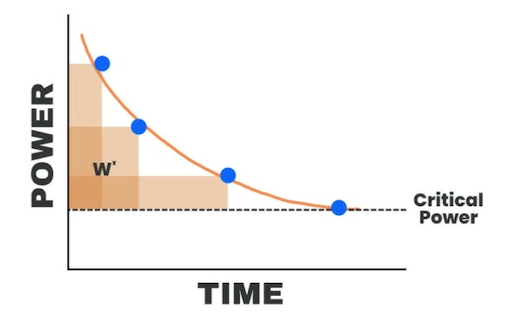
Note – CP refers to the maximal sustainable power for prolonged efforts (typically 35–60 minutes in practice) and marks the boundary between heavy and severe intensity domains, in a 3 zone training model, or How CP and W′ are measured.
Having a high W’ is typically associated with more explosive riders, and is a trait of strong cyclo cross, track and criterium racing cyclists.
How can W’ be useful?
To calculate total time to exhaustion (TTE) in seconds = W’ (Joules) / Watts above CP.
For example:
A rider has a CP of 300W, a W’ of 20000J and is riding at 400W (100W above CP). So, 20000 (W’) divided by 100 (W above CP) = 200 seconds, the length at which the rider can theoretically sustain 400W. If then riding at 200W for 200s, the W’ should be replenished.
Or:
Looking at a rider with a W’ of 18,000 J and CP of 300 W, riding at 360 W (60 W above CP) would deplete W′ in 300 s (18,000 J / 60 J/s) = 5 minutes.
The data allows you to predict durations and residual capacity for other intensities, above CP.
The W′bal model can also be used for dosing intervals – repeated efforts and recoveries.
If recovery periods drop power below CP, W′ starts to recharge.
See the below chart as an example of a rider’s training session, shown in WKO5 analysis software, and shows a rider’s power output (yellow line), which clearly shows two well-executed blocks of 5 Vo2 max efforts, whilst the purple line represents the riders W’ or FRC.
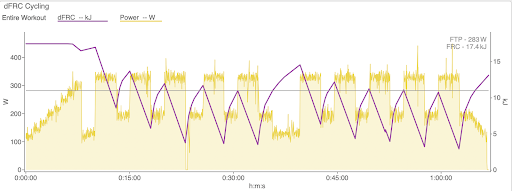
You can see FRC drains through each interval, and is replenished during the rest.
What this file suggests, is that the rider had more in the tank, and could have likely targeted higher power outputs for each interval (assuming motivation was high and sensations were good), or perhaps completed more intervals – depending on the riders goals.
Practical value
- Training prescription: tailor interval lengths and recovery to individual W′ and CP (e.g., 40/20 style intervals based on recharge rates).
- Racing: a larger W′ helps in criteriums, CX, or any event requiring repeated short surges or prolonged efforts above CP.
- Progress tracking: increases in W′ or CP (or changes in their balance) indicate different physiological adaptations.
Caveats and real-world factors
- Tests demand maximal pacing and high tolerance for discomfort — results vary with motivation and pain threshold.
- CP sustainability varies; other limits (neuromuscular fatigue, heat, substrate depletion, psychological fatigue) affect performance.
- W′ and CP are useful frameworks but are approximations — interpret them alongside subjective and contextual data.
How to calculate
Protocol 1 – 3-minute all-out test
- Start with a maximal sprint and sustain full effort for 3 minutes.
- The average power in the final 30 seconds approximates CP.
- W′ is the work done above that CP during the earlier portion (usually the first ~150 seconds).
- Pros: quick.
- Cons: hard to pace perfectly — many athletes reserve energy and under-drain W′.
Protocol 2 – Multiple time trials (recommended)
- Perform 2–3 maximal efforts (e.g., 3 min and 12 min) with long low-intensity recovery (~40 min).
- Fit the power-duration points to a CP/W′ model to estimate both values.
- Pros: more reliable; widely supported in literature.
Article written by Rowe & King Coach, Matt Rowe
@LukeRowe1990
@Dani_Rowe_MBE
@RoweandKing