

What Is Vo2 Max In Cycling?
VO2 Max is a key predictor of performance in endurance sport – and is entirely trainable! Through structured and consistent training (especially targeted intervals), your VO2 max and cycling performance can improve substantially.
What is VO2 Max?
VO2 Max (volume of oxygen max) represents your maximal oxygen uptake/the highest rate at which your body can take in, transport and use oxygen during intense exercise.
As intensity increases, muscles demand more oxygen until your cardiovascular system can no longer meet that demand, at which point, any additional power comes from anaerobic metabolism and is both inefficient and shortlived.
VO2 Max sets the ceiling for aerobic work and is commonly expressed relative to body mass (mL·kg−1·min−1) for comparisons in cycling.
Why is VO2 Max important for cycling?
The higher your VO2 Max, the greater potential for aerobic (efficient and plentiful) power production.
But while a high VO2 Max is important, it’s only part of the picture. How much of your VO2 Max can you sustain at lactate threshold is key.
Fractional utilisation of VO2 Max – the relationship between FTP and VO2 Max (FTP/pVO2 = fractional utilisation)
To illustrate:
If your FTP is 200w and your sustainable power at VO2Max is 240w, your fractional utilisation is 83.3%.
In some cases, cyclists push their FTP to a high fraction of VO2 (between 85-90%). This represents an opportunity to improve VO2 max (or in someone like Chris Froome’s case, a rare genetic gift of efficiency).
Conversely, you can have a low fractional utilisation (below 75%), which means that focusing on FTP is likely going to benefit you more, to bring you closer to the ‘more typical’ range of 75-85%.
What does this mean for me?
Look at the average power you can do 3-5 minute repeats at, and compare with your FTP. If you can do 6x3min repeats at 280W but your FTP is 200W, you would likely benefit from training focused on improving your threshold, since your fractional utilisation is ‘low’ (200/280= .714 = 71.4%)
If your sustainable power at VO2 Max was lower, say 220W against an FTP of 200W, you would likely benefit from training your VO2 Max instead, since you have a ‘high’ fractional utilisation (200/220w = .9 = 90%)
Training to improve VO2max
Repeated efforts that push you near your maximal oxygen uptake (Zone 5) is the most direct stimulus.
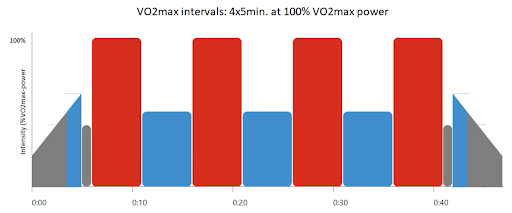
As a suggested workout to train your VO2 Max, look for 15-25 minutes of ‘work’ in Zone 5/just above FTP, i.e. ‘4x 5 minutes at VO2 Max Power (c.105% FTP), with equal work-rest.
The good news is that you can elicit gains in your VO2 Max quickly: c.15% gains in 6 weeks, with a well structured programme.
Typical VO2 Max Workout
What does a “good” VO2 Max look like for cyclists?
Typical relative values (mL·kg-1·min-1):
- Untrained: women ~30-35, men ~40-45
- Trained: women ~40-60, men ~50-70
- Elite: women 55+, men 60+
Top world athletes can reach the 70s–90s; extreme outliers (e.g., Oskar Svendsen ~97.5) exist.
High VO2 Max alone doesn’t guarantee performance, rather it’s your fractional utilisation and efficiency that matter more.
@LukeRowe1990
@Dani_Rowe_MBE
@RoweandKing