

Setting Threshold Power: Functional Threshold Power Vs Critical Power
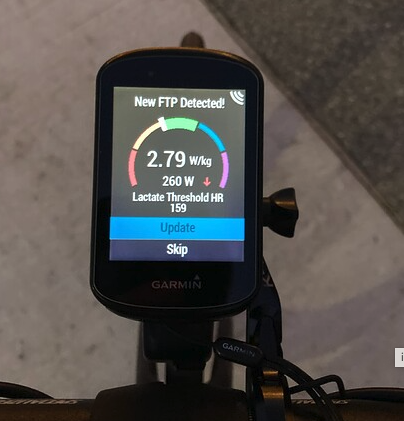
Threshold power is the cornerstone of modern cycling training. It anchors your training zones, shapes interval prescriptions and provides a measurable way to track progress.
Two widely used methods to define threshold power are Functional Threshold Power (FTP) and Critical Power (CP).
Both aim to quantify the upper limit of sustainable effort, but they differ in definition, testing approach and how they’re used to structure training. Understanding each helps you pick the right tool for your goals and the most reliable way to set training intensity.
Bottom line… CP and FTP are both viable options and given that your threshold varies day to day, based largely on fatigue, consistency in approach is the most important.
What is Functional Threshold Power (FTP)?
Functional Threshold Power is commonly defined as the highest power you can sustain for about one hour, usually estimated as 95 per cent of a maximal 20-minute test.
Introduced into mainstream cycling by online training platforms, FTP is practical and easy to test, and it has become a familiar benchmark for riders and coaches.
FTP is often used to set training zones (such as endurance, tempo, sweet spot, threshold, VO2max) and to gauge improvements over a season.
What is Critical Power (CP)?
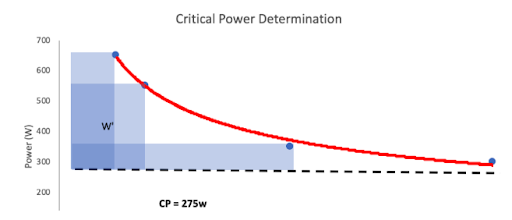
Critical Power (CP) is a concept rooted in exercise physiology. It represents the asymptote of the hyperbolic relationship between power and time – essentially the power you can theoretically sustain for a very long duration without fatigue (practically interpreted as the boundary between heavy and severe exercise domains).
CP is derived from multiple all-out efforts or time-to-exhaustion tests at different durations to populate your power duration curve, and is paired with a finite work capacity above CP (often called W’, of Functional Reserve Capacity (FRC) – think anaerobic battery).
CP provides a model-based view of your power-duration profile and can be more informative about your pacing capacities and the balance between aerobic and anaerobic energy contributions.
Why establishing your threshold matters
Threshold metrics provide consistent anchors for prescribing training intensity. Training at, below, or above threshold elicits distinct physiological adaptations:
- Below threshold (endurance/tempo): improves aerobic efficiency, fat metabolism, and muscular endurance.
- Around threshold: improves lactate clearance, sustainable power, and time-to-exhaustion.
- Above threshold (VO2max/anaerobic efforts): develops maximal aerobic capacity and neuromuscular power.
Accurate threshold setting ensures intervals hit the intended stimulus — too low and you won’t get the adaptation; too high and you won’t complete the session as planned.
Testing protocols
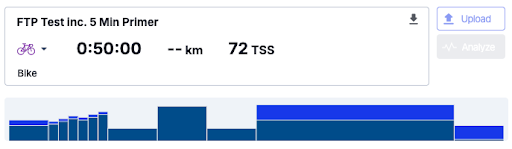
20 Minute FTP Test:
- Warm up 20–30 minutes with some brief efforts.
- (optional ‘primer’ effort to deplete your anaerobic contribution to the test)
- c.5 minute recovery
- Ride a maximal 20-minute time trial on a steady course or erg (no variable surges).
- Average power for the 20 minutes × 0.95 = FTP.
- Alternatively, use a ramp test (shorter maximal efforts with step increases) and convert peak power to an FTP estimate according to the platform’s algorithm.
Critical Power Testing:
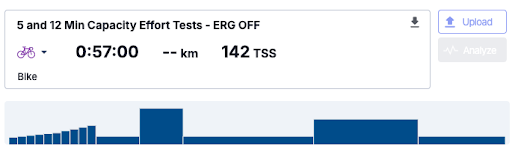
- Requires multiple maximal efforts at different durations (commonly 3–5 efforts) separated by full recovery. Typical durations: ~3–5 minutes, ~8–12 minutes, ~20 minutes (or another combination).
- Record mean power for each effort and plot power vs. time; use a CP model (linear, nonlinear or software) to estimate CP (the asymptote) and W′ (finite work capacity above CP).
- Alternatively, perform repeated controlled maximal tests to exhaustion at set powers for a modelling approach. Many power-analysis tools and training platforms can calculate CP from uploaded efforts.
Similarities between the two:
- Both are used to set training zones and guide intensity distribution.
- Both reflect a meaningful physiological boundary between sustainable and unsustainable efforts.
- Both should be tested periodically (every 6–12 weeks, or after major training blocks) to ensure zones are accurate as fitness changes.
Key differences between the two:
- Definition: FTP is an empirical estimate (often 95 per cent of 20-min power) tied to a practical one-hour concept; CP is a model-derived asymptote from multiple efforts reflecting a theoretical sustainable power.
- Testing complexity: FTP testing is simpler and quicker (single 20-min test or ramp); CP testing requires multiple maximal efforts and modelling.
- Precision and physiology: CP comes from a physiological model and provides W′, offering insight into anaerobic capacity and pacing across different durations. FTP is pragmatic and widely adopted but may slightly over- or underestimate true threshold for some riders.
- Application nuance: CP can be more useful when planning races or efforts that require precise pacing over varying durations (using CP and W′ to predict depletion/recovery). FTP remains highly practical for everyday training plans and platform-based zone systems.
Which should you use?
For most riders, FTP is simple, repeatable, and integrates with training platforms and coaches’ workflows.
Via analysis software such as Training Peaks WKO5, which Rowe & King coaches use, deeper insight into anaerobic capacity, FRC / W′ offer additional useful metrics is achieved.
Practical guidance from pro cycling coach Rowe & King
- Choose a test method that you can perform reliably and re-test consistently.
- Prioritise high-quality warm-ups and recovery between maximal efforts.
- Reassess threshold after focused training blocks or significant fitness changes.
- If you’re unsure which method suits you, or want a guided testing session and interpretation, book a coach-guided test — it’s the fastest way to get actionable, accurate zones.
Both FTP and CP are valuable. The best choice is the one that fits your goals, testing tolerance, and the level of nuance you need for pacing and training prescriptions.
@LukeRowe1990
@Dani_Rowe_MBE
@RoweandKing