

Energy Systems In Cycling
Like a car can run on petrol, your muscles run on adenosine triphosphate (ATP) – the body’s energy currency. The more ATP you can make and use, the more energy available to your working muscles, which translates into more power being produced through the pedals.
Your body has three energy systems that are able to produce ATP:
- Aerobic system
- Anaerobic system
- Anaerobic alactic system (ATP-PC)
What is ATP?
ATP is the fuel that your muscle fibers need to contract. Each energy system produces ATP in a different way, depending on the effort you want to make and the subsequent rate at which your muscles require ATP (energy).
Through training, you are able to increase the efficiency in which energy is produced, meaning you can produce more power aerobically for a given power output, which translates to better endurance and increased durability / ability to resist fatigue.
A look at each energy system
- Aerobic system (oxygen-powered)
- Supplies most of your energy for anything longer than a couple of minutes. Uses oxygen plus glucose or fat via the Krebs/citric acid cycle.
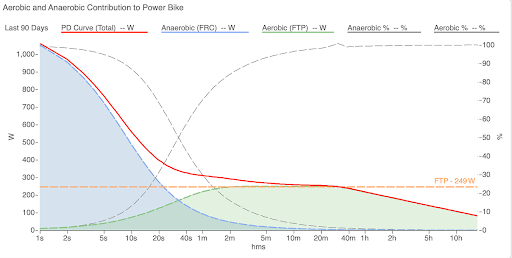
- Primary producer of power, up to the point where your cardiovascular system maxes out and can’t utilise anymore oxygen – at Vo2 Max. Training zone wise, this is from Zone 1, through to Zone 4 – threshold.
- Even above threshold (Zone 4), your aerobic system keeps helping, by producing ATP and clearing by-products from harder efforts.
- Anaerobic system (fast, no oxygen)
- Produces ATP quickly, and is key for very hard efforts ~30 seconds to ~3 minutes, but contributes to energy production whenever you tip over your FTP. Training zone wise, this is Zone 5 (Vo2 Max) and Zone 6 (Anaerobic Capacity).
- Your body breaks down glucose to ultimately generate ATP.
- A key sign that your anaerobic energy system has kicked in, is the burning sensation in your working muscles.
- ATP-PC system (sprint power)
- Produces ATP immediately, and is key for producing max efforts less than 15 seconds. Training zone-wise, this is Zone 7 – Neuromuscular Power.
- Your body uses creatine phosphate to produce ATP quickly and does so anaerobically. It doesn’t produce lactate, so it’s also called the alactic system.
- Whilst a lot of energy is produced very quickly, it requires extended periods of recovery. This is why you have to rest in between sprint efforts.
Contribution of aerobic and anaerobic systems at given power
The chart below is taken from Training Peaks Analysis Software WKO5, showing aerobic and anaerobic contribution to power output on a bike over time, plotted against a typical hyperbolic power duration curve.
In summary – Aerobic vs. Anaerobic vs. Neuromuscular
Combined, your three energy systems pair most efficiently to provide you with the energy required to meet the power your effort demands.
Cycling is an endurance sport, so your aerobic energy system is king… energy production is slow, but plentiful. Conversely, your two energy systems that do not rely on oxygen are able to produce greater amounts of energy quickly, but are unable to sustain such provision.
Your aerobic energy system is always working, and during repeated anaerobic efforts – as your body eats into its Functional Reserve Capacity (think anaerobic tank), these repeated efforts become more aerobic.
Key takeaway
Each energy system requires a different training stimulus, and is tied to your training zones. Each training intensity places a different stress on your body (energy systems and working muscles), which promotes associated adaptations.
Ensure your training intensity distribution is aligned with your goals.
@LukeRowe1990
@Dani_Rowe_MBE
@RoweandKing