

The Science of Zone 2: Why Cycling Steady Builds Your Engine
Ask any World Tour cycling coach what the single highest-leverage session in the sport is and you’ll get a surprisingly boring answer. Not the VO2max blocks. Not the four-hour sweet-spot grinds. The long, steady ride.
The trouble is that “steady” is the hardest intensity to ride well. It feels too slow. The Strava segments slide by ungrabbed. Your training partner pulls away on the first drag.
And so, almost universally, amateur cyclists ride their easy days too hard and their hard days too easy – what coach Stephen Seiler famously dubbed the “moderate intensity trap.”
This article is about why that trap is so costly, and what’s actually happening inside your body when you ride properly in Zone 2.
What is Zone 2 in cycling?
Zone 2 isn’t a number on your power meter. It’s a physiological state, defined by the fuel your body is preferentially burning.
Specifically, it’s the intensity at which:
You burn the highest absolute amount of fat per minute. Lactate stays at roughly resting levels (below ~2 mmol/L). You can hold a full, conversational sentence without breath-stacking. You’re predominantly recruiting slow-twitch (Type 1) muscle fibres.
In power terms, this usually lands at around 56–75% of FTP. In heart rate terms, roughly 60–70% of max HR. But both ranges are approximate. The cleaner test is the talk test – if you have to break a sentence into chunks to breathe, you’ve drifted out of Zone 2.
What physical impacts does Zone 2 have on the body?
Two adaptations matter most:
Mitochondrial biogenesis
Every endurance contraction signals your muscle cells to build more mitochondria – the organelles that produce ATP, the energy currency of every cell.
Dr Iñigo San Millán’s work with Tadej Pogačar and others has shown that low-intensity volume is the most potent driver of mitochondrial density.
More mitochondria means that you can produce more energy aerobically, oxidise more fat and spare your limited glycogen stores for moments that decide a race.
Capillarisation
Zone 2 also stimulates the growth of new capillaries around your working muscle fibres. More capillaries mean a shorter diffusion distance for oxygen, fuels and metabolic by-products – your engine doesn’t just get bigger, the delivery network gets denser too.
There’s a third often-overlooked benefit:
Lactate clearance
Type 1 fibres are unusually good at taking up lactate produced elsewhere in the body and using it as fuel. Train them at Zone 2 and you build an internal lactate shuttle that buys you more headroom at threshold.
What happens to your body in Zone 3?
The instinct, when 90 minutes of Zone 2 feels too easy, is to push into Zone 3 or ‘tempo’. Don’t.
Three things go wrong:
- You shift fuel. As intensity rises, the proportion of energy coming from carbohydrate climbs sharply. Above the first lactate threshold, fat oxidation falls off a cliff. You stop training the very adaptation you came for.
- You blunt the signal. Mitochondrial biogenesis is most strongly stimulated by long-duration, low-intensity work. Adding intensity doesn’t add adaptation – it dilutes it.
- You add fatigue. Tempo work carries a recovery cost. Spend it on Tuesday and Thursday’s intervals are compromised.
Polarised training research – Seiler, Stöggl, Foster – has been consistent for two decades: the highest-performing endurance athletes spend roughly 80% of their training easy and 20% hard, with very little in between.
How to actually ride Zone 2
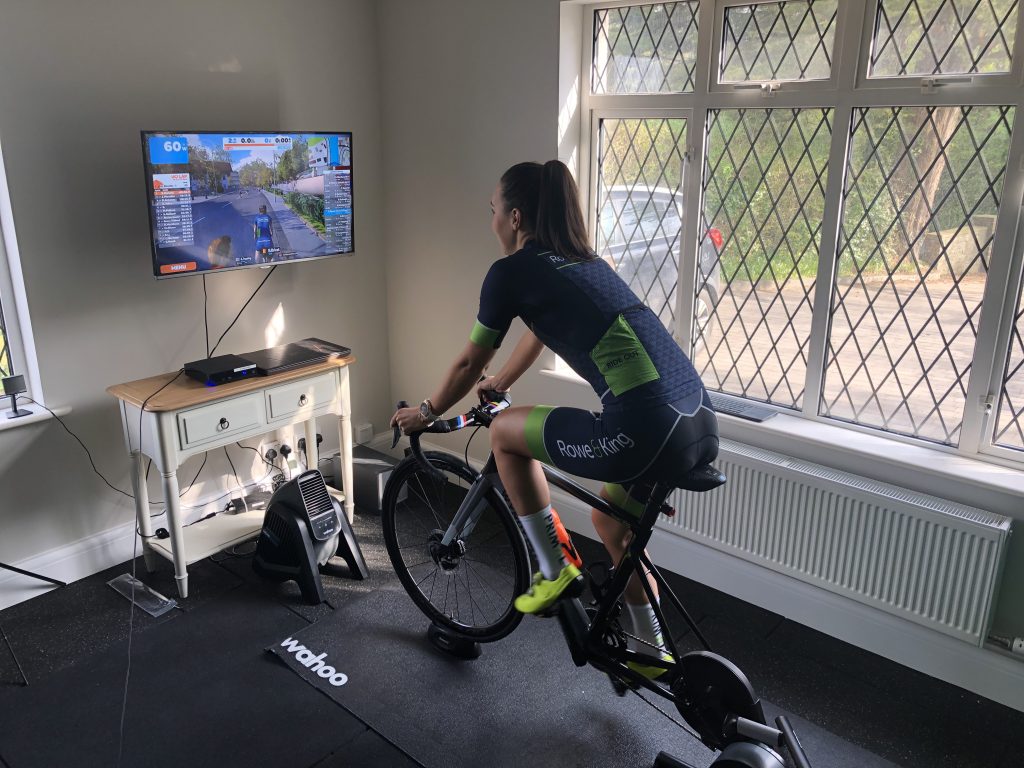
Here are just a few of the practical rules that the Rowe & King coaches give every client starting a base block:
- Use the talk test as your governor. Power and HR drift over a long ride; conversation doesn’t lie.
- Cap it from above, not below. If you’re a 280W FTP rider, treat 210W as the ceiling for the first hour, not the floor.
- Solo where you can. Group rides almost always drift to the front rider’s threshold. If you have to ride in a group, ride at the back and let gaps open.
- Long is the dose. A 30-minute Zone 2 ride is barely a stimulus. The adaptation curve kicks in somewhere between 90 minutes and 2 hours for most riders. If you only have an hour, run an interval session instead and save your easy day for the weekend.
- Fuel it. Counterintuitive, but most riders under-fuel long Zone 2 rides because the perceived effort is low. Take 30–60g of carbohydrate per hour. You’re training a fat-oxidation system that works best when carbohydrate is available alongside it, not depleted from it.
The time-crunched caveat
The 80/20 polarised model that drives elite training assumes elite training volumes – 20-plus hours a week, sometimes 30. The pro who rides 25 hours easy is still putting in 5 hours of intensity.
Most amateurs working with us train 6–12 hours a week. At that volume, you simply cannot accumulate enough Zone 2 time to drive the mitochondrial adaptations that long, steady hours produce in the pros.
That doesn’t make Zone 2 less valuable for time-crunched riders. It changes its role.
For an amateur training under 12 hours a week, the prescription becomes: ride Zone 2 wherever you can – commutes, weekend long rides, anything that adds aerobic volume – and supplement with structured high-end aerobic, VO2max and threshold work to compensate for the hours you don’t have.
The intensity work, in other words, isn’t optional spice on top of a big base. It’s load-bearing.
This is also why the next three weeks of this series matter most to anyone training under 12 hours. The aerobic base sets the foundation. VO2max and threshold do the heavy lifting that elite volume can’t do for you.
How do you know if Zone 2 training is working?
The early signs are quiet. Heart rate at a given power drops. The same Sunday loop feels less destructive on Monday. You can hold a higher pace at the same conversational effort.
Over 8–12 weeks, FTP starts to climb without any extra threshold work – because your aerobic ceiling has been lifted.
The bottom line
Zone 2 is not the glamorous part of training. It’s the foundation that everything else sits on.
Build it properly through a winter base block and your intervals, your sweet-spot work, your VO2max sessions in the spring all land on richer soil. Skip it, and you’ll spend the next 12 months chasing fitness gains that never quite stick.
This is the first article in our four-part Build a Better Engine series. Next Tuesday: VO2max – what it actually is, why it’s the second-biggest determinant of cycling performance after threshold, and the 30/30 session that develops it fastest.
Coached by Rowe & King – built for you.
@LukeRowe1990
@Dani_Rowe_MBE
@RoweandKing